|
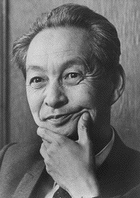 Sin-Itiro
Tomonaga
was born in Tokyo, Japan, on March 31, 1906, the eldest son of Sanjuro
Tomonaga and Hide Tomonaga. In 1913 his family moved to Kyoto when his
father was appointed a professor of philosophy at Kyoto Imperial
University. From that time he was brought up in Kyoto. He is a graduate
of the Third Higher School, Kyoto, a renowned senior high school which
has educated a number of leading personalities in prewarJapan. Sin-Itiro
Tomonaga
was born in Tokyo, Japan, on March 31, 1906, the eldest son of Sanjuro
Tomonaga and Hide Tomonaga. In 1913 his family moved to Kyoto when his
father was appointed a professor of philosophy at Kyoto Imperial
University. From that time he was brought up in Kyoto. He is a graduate
of the Third Higher School, Kyoto, a renowned senior high school which
has educated a number of leading personalities in prewarJapan.
Tomonaga completed work for Rigakushi (bachelor's degree) in physics at
Kyoto Imperial University in 1929, with one of his intimate friends. Dr.
Hideki Yukawa,
Nobel laureate. He was engaged in graduate work for three years at the
same university and was then appointed a research associate by Dr.
Yoshio Nishina at the Institute of Physical and Chemical Research, Tokyo,
where he started to work in a newly developed frontier of theoretical
physics quantum electrodynamics - under the guidance of Dr. Nishina. His
paper on the photoelectric pair creation is well-known.
Tomonaga stayed in Leipzig, Germany, from 1937 to 1939, to study nuclear
physics and the quantum field theory in collaboration with the
theoretical group of Dr. W. Heisenberg, where he published a paper
"Innere Reibung und Wärmeleitfähigkeit der Kernmaterie",
which was chosen as the thesis for Rigakuhakushi (Doctor of Science) at
Tokyo Imperial University in December,1939.
In 1940, Dr. Tomonaga directed his attention to the meson theory and
developed the intermediate coupling theory in order to clarify the
structure of the meson cloud around the nucleon. He joined the faculty
of Tokyo Bunrika University (which was absorbed into the Tokyo
University of Education in 1949) as Professor of Physics in 1941. It was
in 1942 when he first proposed the covariant formulation of the quantum
field theory in which the concept of the quantum state was generalized
so as to be relativistically covariant.
During the Second World War, Dr. Tomonaga was interested in developing a
theory of microwave systems. He solved the motion of electrons in the
magnetron and also developed a unified theory of the systems consisting
of wave guides and cavity resonators.
As soon as the War was over, Tomonaga came back to academic research
again with a programme in which he was first to summarize and extend the
intermediate coupling theory and secondly to apply the covariant field
theory to actual physical systems. His aim was to investigate the nature
of field reaction in the meson theory as well as in quantum
electrodynamics. He was confident, prior to the Lamb-Rutherford
experiment, by means of a model calculation that divergence difficulty
in quantumelectrodynamics could be overcome simply by handling the
infinite mass and charge due to field reactions in some way or another.
It was only a step further for him to develop the renormalization theory
with covariant formalism in his right hand and experimental support in
his left.
Dr. Tomonaga was invited to the Institute for Advanced Study, Princeton,
in 1949 where he was engaged in the investigation of a one-dimensional
fermion system. Thus he first succeeded in clarifying the nature of
collective oscillations of a quantum-mechanical many-body system and
opened a new frontier of theoretical physics, modern many-body problem.
In 1955, he published an elementary theory of quantum mechanical
collective motions.
Dr. Tomonaga took the leadership in establishing the Institute for
Nuclear Study, University
of Tokyo,
in 1955. From 1956 to 1962 he was appointed President of the Tokyo
University of Education and since 1963 he has been President of the
Science Council of Japan and Director of the Institute for Optical
Research, Tokyo University of Education. He occupies an important
position in various governmental committees for scientific research and
policymaking.
Tomonaga's honours and awards include the Japan Academy Prize (1948);
the Order of Culture (1952); the Lomonosov Medal, U.S.S.R. (1964).
Dr. Tomonaga is a member of the Japan Academy, the Deutsche Akademie der
Naturforscher "Leopoldina" and a foreign member of the Royal
Swedish Academy of Science.
He is a corresponding member of the Bayerische Akademie der
Wissenschaften and a foreign associate of the National Academy of Science
of U.S.A.
Tomonaga has published widely in scientific journals on such subjects as
quantum electrodynamics, the meson theory, nuclear physics, cosmic rays,
and the many-body problem. His book, "Quantum Mechanics", was
published in 1949 and translated into English in 1963.
Tomonaga was married in 1940 to Ryoko Sekiguchi, daughter of Dr. K.
Sekiguchi, the former Director of the Tokyo Metropolitan Observatory.
They have two sons, Atsushi and Makoto and one daughter. Their daughter
was married in 1965 to Dr. Y. Nagashima, research associate of the
Physics Department, University
of Rochester.
Sin-Itiro Tomonaga died in 1979.
|
Related
links:
|
